Watch the race: 32″ vs 29″ gravel wheels
The film is rendered live by the simulator in your browser, from the same physics you can change yourself. It takes 5:39 and has narration and captions.
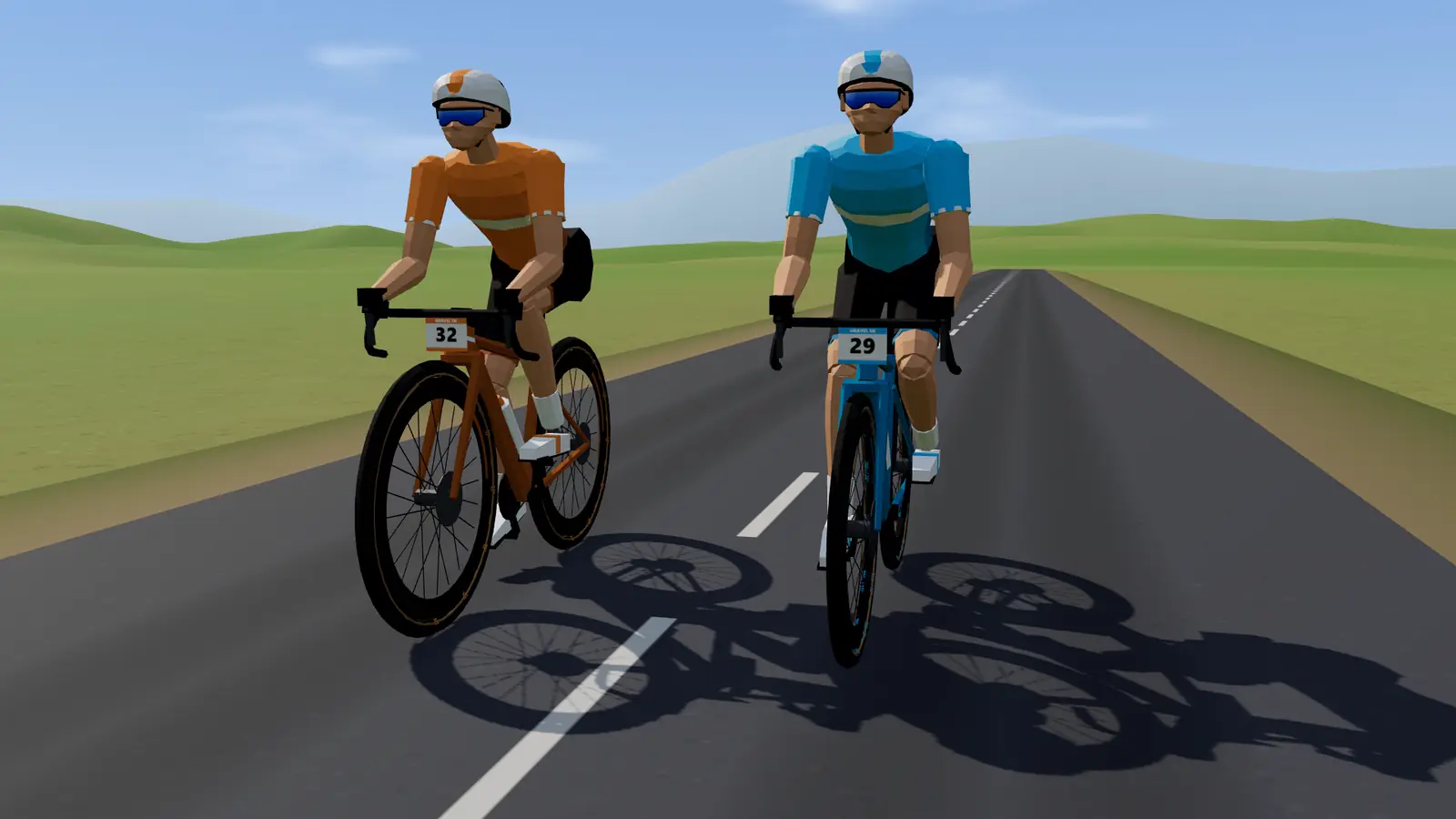
32″ vs 29″ gravel wheels: the full race
Same rider, same 220 watts, ten surfaces. Each segment gets a close look at what the bigger wheel does differently, the seconds it gains, and the running total.
Chapters
- Segment 1: smooth pavement
- Segment 2: smooth hardpack gravel
- Segment 3: a 4 percent climb on rough gravel
- Segment 4: a 6 percent climb on chunky gravel
- Segment 5: washboard
- Segment 6: cobblestones
- Segment 7: roots across the trail
- Segment 8: descending at 5 percent
- Segment 9: smooth hardpack gravel
- Segment 10: smooth pavement
- The result
- How sure is that?
Shorts
Five vertical clips of about 35 seconds, each answering one question.
Do 32″ wheels really roll over roots easier?
38 seconds · the angle of attack on roots32″ wheels are heavier. Do they lose on a climb?
38 seconds · weight against rolling resistanceWashboard gravel: does a bigger wheel help?
38 seconds · bridging the corrugationsAre 32″ gravel wheels really faster? It depends who you ask
33 seconds · the range from sceptic to makerSame rider, same watts, ten surfaces: which wheel wins?
35 seconds · the whole 5 km raceFrom the test bench
The film uses numbers from real-world tests. The clearest one to watch is the back-to-back test of two matched gravel bikes by Ben Delaney and John Karrasch:
The Ride with Ben Delaney: 32″ vs 700c on matched Stinner gravel bikes (YouTube) ↗
All other sources, with links, are on the Research page.
Transcript of the film
32-inch wheels are the newest idea in gravel. They should roll over bumps more easily, but they are heavier and catch more wind. So are they faster?
Here is a physics simulator racing them. Same rider. Same 220 watts. Same 50 millimetre tyres, at matched pressure.
The 32-inch bike is 428 grams heavier, its wheels have 34 percent more inertia, and it pushes a little more air.
The course: 5 kilometres in 10 segments, from pavement to rooty trail, with 58 metres of climbing. Every bump is simulated.
Segment 1: smooth pavement. No bumps here, so the only help is tyre flex. A bigger wheel has a longer, flatter contact patch, so the casing bends less.
The 32-inch wheel gains 0.1 seconds on the 500-metre long paved segment.
Segment 2: smooth hardpack gravel. Now the surface gives a little. The longer contact patch spreads the load, so the 32-inch wheel sinks in less and wastes less energy.
The 32-inch wheel gains 0.6 seconds on the 700-metre long smooth gravel segment. Total lead is 0.7 seconds.
Segment 3: a 4 percent climb on rough gravel. Now weight matters: 428 extra grams cost about 0.8 watts. Rolling gains have to beat that.
The 32-inch wheel gains 1.2 seconds on the 600-metre long rough gravel climb. Total lead is 1.8 seconds.
Segment 4: a 6 percent climb on chunky gravel. Now weight matters: 428 extra grams cost about 0.8 watts. Rolling gains have to beat that.
The 32-inch wheel gains 1.4 seconds on the 450-metre long chunky gravel climb. Total lead is 3.3 seconds.
Segment 5: washboard. Corrugations hit both wheels in rhythm. The 32-inch wheel bridges the dips better, so the frame shakes 19 percent less.
The 32-inch wheel gains 1.8 seconds on the 400-metre long washboard segment. Total lead is 5.0 seconds.
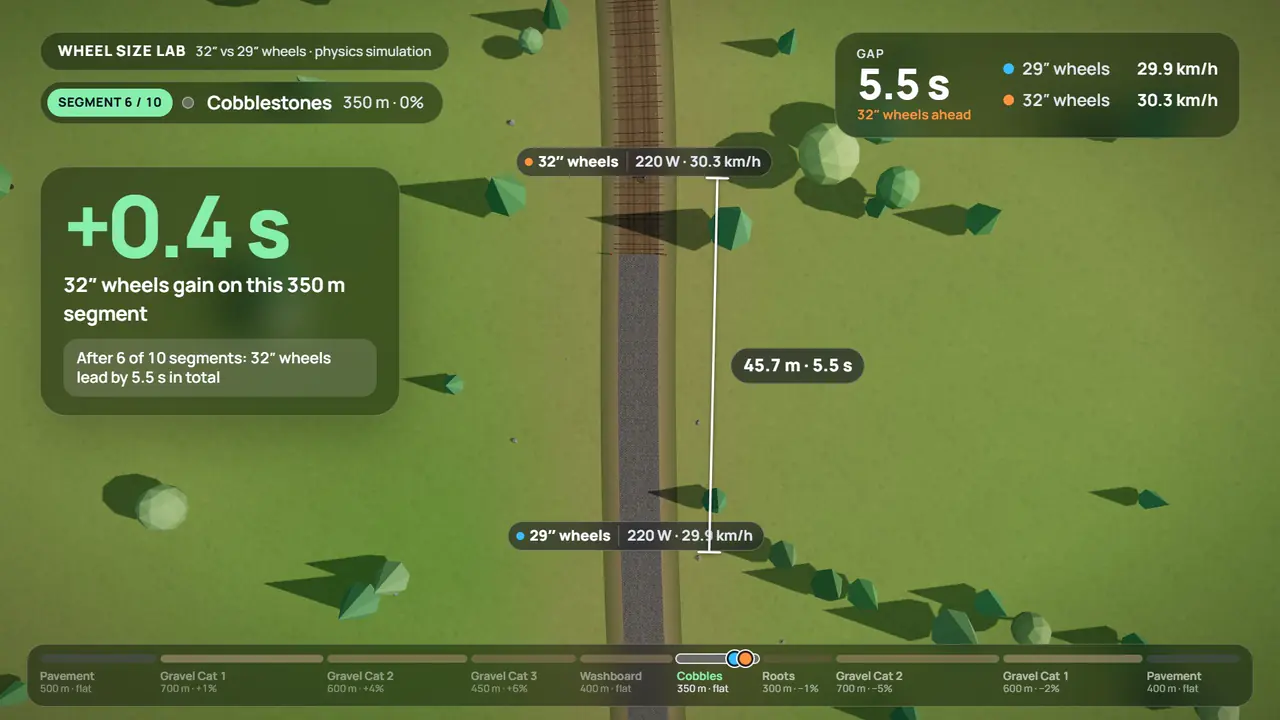
Segment 6: cobblestones. Hard edges and deep joints. The bigger wheel drops less into each gap, but cobbles are firm, so there is no loose-surface bonus.
The 32-inch wheel gains 0.4 seconds on the 350-metre long cobbled segment. Total lead is 5.5 seconds.
Segment 7: roots across the trail. Here the geometry is easiest to see. The bigger wheel meets each obstacle at a shallower angle, so every hit slows it less.
The 32-inch wheel gains 0.4 seconds on the 300-metre long rooty segment. Total lead is 5.9 seconds.
Segment 8: descending at 5 percent. Speeds are high, so air drag dominates. The bigger wheels show more frontal area, but the heavier bike gets a little more help from gravity.
The 32-inch wheel gains 0.3 seconds on the 700-metre long rough gravel descent. Total lead is 6.1 seconds.
Segment 9: smooth hardpack gravel. Now the surface gives a little. The longer contact patch spreads the load, so the 32-inch wheel sinks in less and wastes less energy.
The 32-inch wheel gains 0.2 seconds on the 600-metre long smooth gravel segment. Total lead is 6.3 seconds.
Segment 10: smooth pavement. No bumps here, so the only help is tyre flex. A bigger wheel has a longer, flatter contact patch, so the casing bends less.
The 32-inch wheel gains 0.1 seconds on the 400-metre long paved segment. Total lead is 6.5 seconds.
At the line, the 32-inch wheel wins by 6.5 seconds after 12 minutes. That is 0.9 percent, like finding 3 extra watts. Most of it came from rough and loose ground.
How sure is that? It depends whose data you trust. On the sceptic's numbers the 32-inch wheel loses by 2.1 seconds. On the maker's data it wins by 14.7. Every test is small, and none is peer reviewed.
So: probably faster, mostly on rough and loose ground, but by less than the headlines suggest.
So, are 32-inch wheels the future of gravel? Tell me what you think in the comments.